




Give Me Liberty: Virginia & the Forging of a Nation
July 6 @ 9:00 am – 5:00 pm
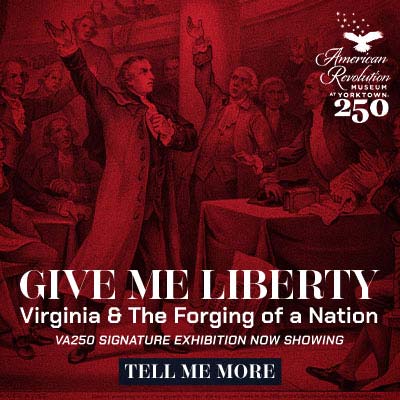
Give Me Liberty: Virginia & the Forging of a Nation
📅July 1, 2026 – January 31, 2027
🕞9 AM – 5 PM
📍American Revolution Museum at Yorktown
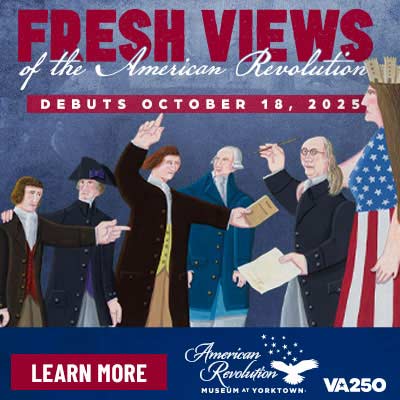
Give Me Liberty: Virginia & the Forging of a Nation marks the 250th anniversary of the Signing of the Declaration of Independence, is your opportunity to view in person two copies of the Declaration of Independence – one early July 1776 broadside printing and then an 1833 engrossed printing from an engraved plate of W.J. Stone. Both are part of the Jamestown-Yorktown Foundation collection.
The exhibit is presented by the Virginia American Revolution 250 Commission and produced in partnership with the Jamestown-Yorktown Foundation and the Virginia Museum of History & Culture, and explores Virginia’s leading role in the American Revolution. Through civic stories and accomplishments of the people who helped shape a new nation the tales of what led up to the Revolution through the eyes of the Revolution generation is considered.
“We really wanted to explore not only the meaning of freedom and the history of this moment but the ongoing experiment; the idea of forming a more perfect union,” explained Christy S. Coleman, executive director of the Jamestown-Yorktown Foundation. There is the story that first began in 1773 as written conversations between 13 colonies, who had never really dealt with each other before, they were essentially separate enterprises of government, but they came together to discuss their concerns and grievances with King and Parliament, and that is included” in this exhibit.
There were three things the organizing Committee wanted to convey in this exhibit, curator Harvey Bakari, Jamestown-Yorktown Foundation’s curator of Black History and Culture relayed. First, was to recognize the community: everyone that was affected by the Declaration of Independence. Second, they wanted the Exhibit to be relevant to today’s audience and third, they wanted it to be engaging, to have some activities and then a call to action. For example, what can you do as a citizen today with the legacy of the seeds of Liberty?
This exhibit also explores the forging of a nation, not having a blueprint, and realizing that the nation would not be a finished product but would take centuries to forge, not just a result of revolution. For example they did not have a standing army or a government, all of this had to be formed during and after the Revolution.
Then there is the contested American narrative – as it was being created there were two races: the enslaved and free African Americans and the Indigenous Nations who were mostly excluded from the narrative. But their subsequent generations would also rewrite the history of the Revolution. “The audience might come in and think the exhibit is trying to be modern, they’re trying to be inclusive,” Bakari challenged. But instead what “we’re trying to do is to give you a chance 250 years out, to see the American Revolution through the eyes of the founding fathers and the people from the American Revolution generation. What did George Washington see? Black soldiers, Indigenous allies, and our French allies fighting against the British. The eyes of Billy Flora, a free black hero of the Battle of Great Bridge. He was also here at the siege of Yorktown. What did he see versus contested histories written by, in many cases, people who were not part of the American Revolution generation. We try to give you the viewpoints of that generation: the Revolutionary generation. Not the narrative, not the filler but to give you a chance to see what they saw here in Virginia.”
Travis Henline, the Curator of Indigenous History and Culture stressed that Revolutions do not happen in a vacuum and that there were decades that preceded the American Revolution where these grievances and ideas formed. He pointed out that it was “a time where people had to make hard choices, while some may have wanted to remain neutral at the onset of this conflict, as it proceeded very few had the opportunity to do so. People began to realize that rights were not a spectator sport, and this touched everyone.” Henline explained that “this Revolution faced all people and we tried to be as inclusive as possible to bring those stories forward.”
Sarah Meschutt, Senior Curator, American Revolution Museum at Yorktown compared and contrasted the different printed copies of the Declaration of Independence in the exhibit and their uses. The exhibit has an early broadside like the ones printed on July 4 & 5 of 1776 by John Dunlap, the official printer to the Continental Congress in Philadelphia. These were intended for broad quick distribution, posted in public squares and read to the troops. The exhibit also has a large signed copy you will see in the center of this exhibit which was commissioned and completed 50 years later when the original parchment document was aging.
“The whole point of the Declaration was to engage the people in the idea behind democracy, a government for the people. So the Declaration had to be circulated and the way it was disseminated in the 18th century was through print culture. These Dunlap copies were circulated to the Army and read to them by George Washington and other generals, then the horseman would carry it to the other colonies.” Broadsides tucked in saddle bags spread the ideas of revolution across the colonies.
The American Revolutionary Museum at Yorktown has a very early printed broadside copy in the main gallery. It was printed in Boston on July 18th of 1776 which is less than two weeks after the first July 4th printing. When the British took control of Philadelphia the printing went to Baltimore where a woman printer, Mary Catherine Goddard printed the first with signatures printed on the image. “Those were distributed for ratification by the Colonial Governments, the States,” explained Meschutt. Having seen all the signatures of the Goddard prints it was ratified and subsequent copies were produced.
This now brings us to the large glass encased Declaration of Independence that you will see in the center of this Exhibit. Meschutt highlights that “it was most important because it was engraved in 1823 on a large copper plate where the signatures could be reproduced exactly.” It would take William Stone, the engraver, three years to produce it. It was produced 50 years to the date of the July 4th Declaration of Independence. John Quincy Adams and a committee of Congress were worried about the original as the parchment Declaration of Independence was deteriorating.
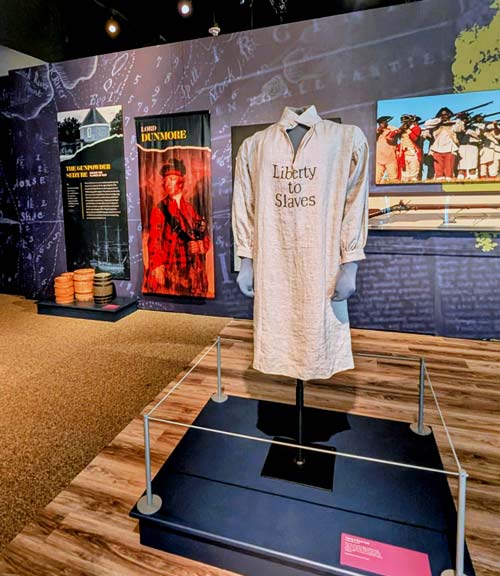
The Exhibit through graphic displays, artifacts and multimedia components takes the time to give the audience insight into the different races, genders and nationalities of the people of the Revolutionary generation. These are histories that may be unknown to visitors but are a documented part of our shared history.
The Exhibit has seed paper at the end of the exhibition, as a way to ensure visitors think about the way that revolutionary challenge continues today. The museum invites visitors to take seed paper and write their commitment to Liberty as we move forward as a county. Visitors can then plant it and watch it grow.
The exhibition is included with general admission to the American Revolution Museum at Yorktown. Residents of James City County, York County, and the City of Williamsburg–including William & Mary students–receive complimentary admission with proof of residency, and parking is free.
For more information, see here.